
Leadership Q&A: Stuart Martin, Space Industry Leader & Chair of the National Space Centre
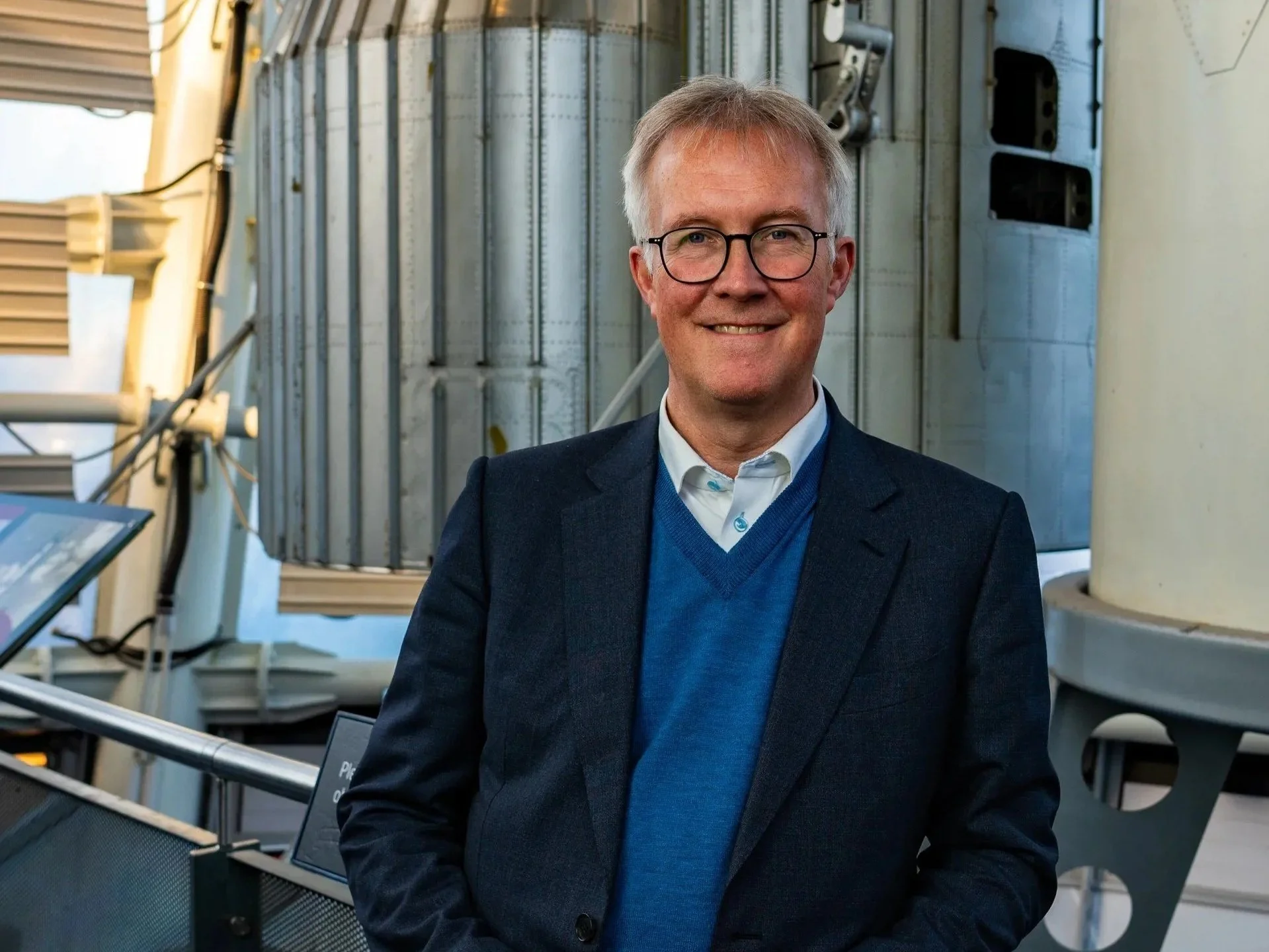
The Space sector operates in a market where innovation, long-term thinking and complex stakeholder collaboration are a given. For Moon Executive Search, it therefore seems fitting that our second Leadership Q&A should feature Stuart Martin, one of the leading figures in the UK space industry.
As the founding CEO of the Satellite Applications Catapult, Stuart spent more than a decade helping to establish and scale what is now a thriving community of space businesses, innovators and investors in the UK.
Stuart brings that diverse portfolio career experience to his numerous roles, as Chair of Space Solar, Non-Executive Director at AAC Clyde Space, Visiting Professor at Imperial College London, Partner at the Space for Earth Growth Fund, and Chair of Trustees at the National Space Centre.
In this Leadership Q&A, Stuart discusses why organisations must pursue change, innovation and why authenticity may become one of the most important leadership capabilities in an AI-driven world.
Vanessa Moon: “What leadership lessons from the space sector do you think every CEO could benefit from?”
“At its heart, space is a high-risk sector. Anything in space has to survive the violence of a rocket, and after that it must work first time. There is no possibility to return to manufacturer for repairs if it doesn’t. (At least for now!) As a consequence , risk tolerance within the industry leading up to launch is very low, to maximise chance of success in orbit. This has lead to high-levels of regulation and standardisation, and an orthodoxy across the sector which has been very resistant to change.
What has changed over the past 10 years is that those who want to do things differently, who want to challenge the status quo, are being embraced by the sector. Previously, the pioneers who wanted to push the barriers would have been resisted. They’d have been told what they were doing was impossible, and they would fail to get support of the institutions and regulators that was available to those operating within the ‘rules’. This killed many promising concepts and ideas, but fortunately enough carried on anyway to make success of their innovations. So now everyone benefits from cheap, reliable launches, low-cost satellites based on consumer electronics, and a new generation of global, low-latency communication systems in low-Earth orbit (LEO). And there is a new generation of innovators that is taking technology in space to a whole new set of possibilities – drug and semiconductor manufacturing, AI data centres, even 24x7 solar power for the Earth.
Perhaps paradoxically, it has taken the space sector a long time to embrace genuine commercial innovation. Now more than ever, all sectors need not just to be open to, but to actively pursue change to stay ahead and relevant in this fast moving global economy.”
Vanessa: “You've worked across corporates, start-ups and public-interest organisations. What does innovation mean in each of those environments?”
“I once attended an “Innovation Dinner” hosted by a senior civil servant. His opening question to the table, which included leaders from science, industry and government, was: “When we talk about innovation, do we all mean the same thing?”
“I do hope not,” I replied.
He looked momentarily puzzled. His intention had clearly been to establish a common definition before the discussion began. But for me, innovation has always been a little like art: it resists neat definitions and refuses to stay within the lines we draw around it. The most transformative innovations are often those that look unlike anything we’ve seen before. Rather than trying to constrain innovation with a single definition, I think we should be comfortable with the fact that different people see it through different lenses, while still recognising it when it appears.
That difference in perspective is especially evident when comparing government and industry. In government, innovation is often viewed as the process of converting scientific discovery into a specific technology or capability. That was very much the lens through which my civil servant host saw the world.
In industry, however, innovation is usually defined much more broadly. It is often less about inventing the technology itself and more about applying technology in novel ways to create value, solve problems or improve outcomes. As a result, many of the most significant innovations in business are delivered not through laboratories and R&D programmes, but through smart procurement, partnerships and adoption strategies.
Interestingly, suggesting that procurement can be a vehicle for innovation often raises eyebrows in government circles. Yet some of the most impactful innovation I’ve seen has come not from creating something entirely new, but from spotting an opportunity, connecting existing capabilities differently, and applying them in ways others hadn’t considered.
The organisations that innovate best aren’t always those with the biggest R&D budgets. They’re the ones willing to challenge assumptions, embrace uncertainty and act before the answer is obvious.”
Vanessa: “The space sector depends on collaboration between industry, government and investors. What have you learned about leading in such complex stakeholder environments?”
“One of the things I enjoy most about working in the space sector is the opportunity to work with some fantastic colleagues across government, industry, academia and (increasingly) investors. Pretty much every space activity involves at least three of these communities, and most likely all four – and quite likely there are international partners in the mix too. The key to success is for all parties to understand and appreciate the motivations, risks and constraints that each of the other parties is subject to. They are not the same, and they are not always easy to determine. Consequently, it is worth investing in the senior relationships early on, to understand these issues right from the start, so that you are not only trying to do this when are there are problems to solve too.”
Vanessa: “The space industry requires leaders to think long term. What lessons around strategy and planning do you think other sectors should heed?”
“Until recently, investments in space infrastructure had pay back times of 10-15 years. That required a great deal of planning, and security of long-term contracts with customers, in order to be confident of revenues over that type of time frame. These days, because of the reduced cost of space infrastructure and the pace of change of the technology, 5 years is considered a long time for the active life of a space asset. This means that technology development and deployment is a continuous process, rather than on a 10-15 year cycle. So the business model has fundamentally changed – companies must expect to finance continuous refurbishment through revenues, with equity investment at the start to boot strap, rather than using project finance for each new asset then repaid over its lifetime.
This new paradigm opens up new possible for strategy and planning. You don’t need to understand how the market will behave over 10-15 year timeframes. However, you can set goals over those timeframes to maximise returns for investors, and build towards them taking advantage of much shorter-term technology iterations that take into account changes in customer behaviours and geopolitical events along the way. A good current example is the way that many space companies are developing “dual use” platforms, that serves short-term needs of defence and intelligence customers whilst building longer-term capability aimed at the much larger commercial markets. This strategic integration of short-term and long-term planning is very attractive to investors, and something I think many other companies could benefit from.”

Vanessa: “What leadership capability do you think organisations will need most over the next decade?”
“However much things have changed over the past 10 years, the next 10 years will change much more. This will be the period when the biggest impacts of AI across all industries are realised. It is already starting to feel to many, that the needs of AI are starting to take priority over the needs of people – whether that is energy for data centres, rights of access to copyright material or the apparent ability to operate with impunity outside of regular legal frameworks. The reaction to this is already starting, and a key place where this will playout is what people look for in their leaders. Leaders over this period will need to be able to communicate their sense of self, and demonstrate their authenticity. People will want to work for people who are demonstrably human and leading the technology. Whatever jobs people end up doing, they won’t want to feel like they are human cogs in an AI-driven industrial machine.”